Friday, June 17, 2016

School’s out for summer….


One of two dance skits for the ceremony
No event is complete without a coffee ceremony
Well almost. We celebrated the last day of the semester yesterday with a ceremony that involved a couple of drama skits, a dance contest, and several farewell speeches for the graduating class. It was the last time that the whole school would be together before exams start. Today, the level IV students will take their exams while the level II students take their exams next Friday.  For the level IV students, it will be a culmination of two years of studies at Mary Help College (“MHC”). After passing the exam, they will receive a Certificate of Competence (“COC”) which will allow them to apply for university as well as get decent paid jobs.  The level IV students won’t re-unite until graduation day which is three weeks away. For those students who don’t pass the exam, they will get one more try in two weeks so that they can make it for graduation. Meanwhile, the level II students will need to pass the exam in order to continue to their second year (or level III) of studies at MHC. 


Classmates dance off the last day of school.


Level IV IT students dressed to impress on exam day
Many of these students come from villages and other remote areas to attend MHC. Their dedication and commitment to improve their standing and prospects for a better future for themselves and their family is very remarkable and inspiring.   It has been a difficult semester for many these students; several lost close family members while a couple of students gave birth. But somehow their adversity shines through and they continue to finish their schooling so that they can obtain the CoC.  Some students are forced to stop their studies mid-way in order to find a job to support their families who depend on them.  Nevertheless, these students represent a bright future, not just for themselves and their families but also for the continuous development of their country.
Final instructions prior to starting the exam


Sunday, May 1, 2016

Celebrating the Easter Triduum

Our international Easter egg basket
In Ethiopia, the end of the Lenten season culminated today with the celebration of Jesus Christ’s resurrection.  I am really happy to have experienced the Easter Triduum (Holy Thursday, Good Friday and Easter Sunday) here in Dilla, especially at MHC Church, where the faith of its parishioners is expressed in such a lovely and joyous manner.  Holy Thursday began with the Evening Mass of the Lord’s Supper during which time the priest washed the feet of 12 church members, just as Jesus Christ washed the feet of his 12 disciples.   Adoration of the Blessed Sacrament followed and all crosses within the church were covered in preparation of the celebration of the passion and death of Jesus Christ on Good Friday.

Our Easter Candle at church.
Good Friday was by far one of my most memorable experiences of expression of faith.  The parishioners gathered at another Catholic church about 5 km away at around 8AM to begin a series of prayers, chants, and reading of the liturgy that lasted to about 2PM.  In between the readings and singing, were several periods of genuflections that would last about 15 minutes during which time they recite “Lord have mercy”. Everyone physically capable (including yours truly) took part in these acts of reverence and worship (needless to say, many of us still have sore legs and thighs, and somebody even fainted due to exhaustion). 

 
Genuflecting in prayer.

Resting and chanting.
We finished after 2PM and were supposed to walk back to MHC Church to be there by 3PM to commemorate the time that Jesus Christ commended his spirit to the Lord while on the cross.  However, heavy rain showers delayed our departure but once the rain dissipated, the majority of us made the 30-45 minute walk back to the church under a light shower and smarting legs.  After acting the Way of the Cross and having a small service, we all gathered outside the church to break our fast with sweet tea and a platter of beans (gurban) and bread (dabo). So by 6/6.30 PM we finished a long day of celebrating the Lord’s Passion; it was a Good Friday that I will never forget.

Helping out in the kitchen.
Holy Saturday was spent preparing for the feast and joy that follows the resurrection of Jesus Christ. I spent most of the day helping the sisters with the Easter decorations and cooking.  After a small meal, we went to attend the Easter Vigil Mass, which began at 11PM with a bonfire outside the church.  The Easter Candle was lit from the fire that was blessed by the priest. We then entered the dark church in procession with all our candles that were lit from the blessed fire of the Easter Candle.  It was not until midnight when the liturgical readings were interrupted to celebrate his resurrection. We continued the mass until 2AM and afterwards we had a small celebration at the Sisters home with tea and Italian Colomba bread.  The weekend ended with another mass early on Sunday morning, where joyous singing and prayers punctuated the festive atmosphere of Jesus’ resurrection.


Delighted with my new Ethiopian shirt.
Celebrating Easter in Dilla, and particularly with the people at MHC Church, was a true delight, as they helped me understand what it truly means to celebrate the passion and death of the Lord.  

Wednesday, April 27, 2016

Adoption Day at the Salesian Compound


Children arriving to the compound.
In Ethiopia, the Easter celebration started this past weekend with Palm Sunday since the country follows the Eastern Orthodox calendar.  For numerous children in Dilla, however, Easter is also a time in which they receive donations from their foreign sponsors.  Over three hundred children from poor families have been “adopted” by foreign sponsors who give annual contributions of between 50 to 100 euros.


One of many happy faces that day.


The adoption process and distribution of contributions are organized by the Salesian Sisters, who select children from poor families, irrespective of religion. Some of these children are adopted as early as 2-3 years old and can continue to be sponsored up to and through high school or college, depending on the financial capabilities of the child or family.  

Brother and sister in queue.


Three times a year the children gather in the Sisters compound to receive their contributions, which take place on Easter, during the Ethiopian New Year in September and once again during Christmas.  Typically in September, which is the start of the school year, the Sisters will use the funds to buy school supplies and pay for the child’s school fees.  During Christmas, the contributions can come in the form of clothing, money or food.  


The children waiting to receive the contributions.


This past weekend, the funds were used to purchase flour and laundry soap (each child received 10 kilos of flour and four bars of soap). These are essential items for their families to have, especially the flour that is used to bake the fasting bread (dafu dabo) that they eat during Easter time.  


Children lined up to receive their 10 kilos of flour.
Some families have as many as two or three children enrolled in the adoption program since they rely on these contributions to support their children.  Even one of our teachers, who was an orphan, had financial support from her foreign sponsor up until her graduation from college last year.  

This is just one of many ways in which the Salesian Sisters have been helping the local people in Dilla, which they have been doing for 30 years – it’s amazing work!
Newly adopted children receiving school supplies
donated from an Italian sponsor
A happy Easter for this young
 child with her new bag.
Carrying 10 kilos is heavy work!
Carrying 10 kilos on one's head is not a problem for this strong boy.


Sunday, April 24, 2016

Palm Sunday in Dilla

Getting ready to bless the palm leaves
in front of MHC Church 


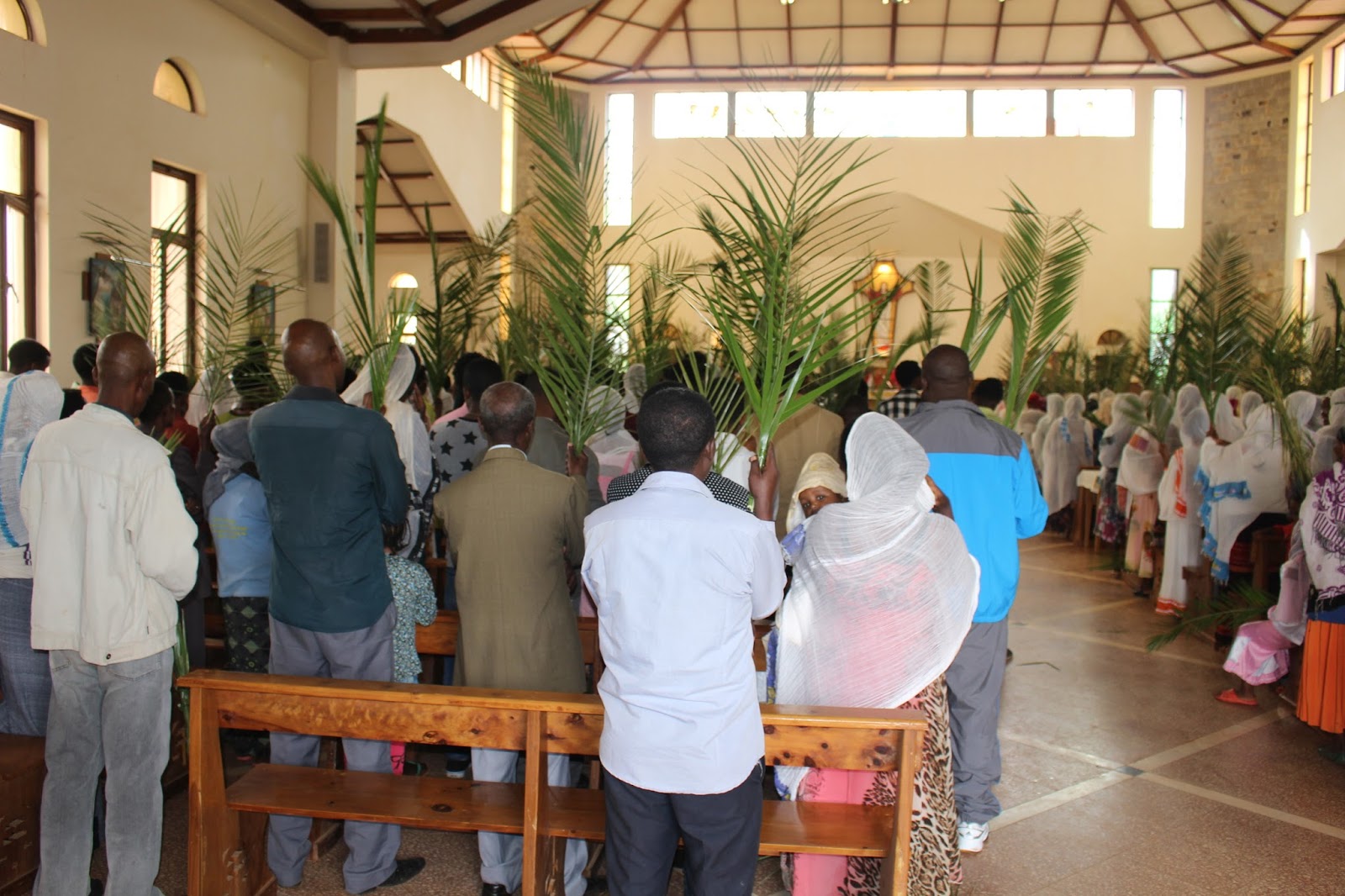
Today, we celebrated Palm Sunday at Mary, Help of Christians Church in Dilla.  It was a lovely mass that commenced with a procession outside of the church to bless a large pile of palm fronds.  They were distributed amongst the merry parishioners who then continued the procession into the church to start mass.  Songs were sung gaily by the ceremoniously dressed choir while the churchgoers enthusiastically waved their palm fronds in the air. 
The alter boys getting ready to start the procession.
The choir leading the procession.


The choir has not used their electric keyboard or drum to accompany their songs during Lenten season, so it was with great excitement that these musical instruments were once again being used as accompaniments to their songs.   The atmosphere in the church was livened by the multiple fronds strewn across the flower and by the children wearing creative rings and crowns made out of the palm leaves. It has been a while since I have attended mass on Palm Sunday so I thoroughly enjoyed the way they celebrated it here in Dilla even though it took the better part of three hours to conclude.  Nevertheless, I am eagerly waiting for the Easter celebration to continue, which will recommence on Holy Thursday and conclude on Easter Monday. 

The brightly colored umbrellas are a
traditional part of the Ethiopian mass.

The blessed palm fronds being distributed to the people. 
Sr. Agnese distributing palm leaves.


The palms are being waved while singing Hosanna.

The young people's choir in action with their drum (kabaro).
The church was streaming with palm leaves.


A crown and ring made of palm leaves.
The girls modeling other palm fashion styles.

The boys eager to show off their palms.

Sunday, April 3, 2016

Traffic Mayhem

Donkeys carrying firewood to the market.
 If you thought driving on I-395 / I-495 in D.C. or the Palmetto Expressway in Miami was a pain, you should try driving through the streets of Dilla.  You can find every conceivable obstacle to crash into, yet somehow hardly any accidents occur in this organized chaos. So what can you encounter while behind the wheel you ask? How about:


Donkey cart with jerrycans.


Rickety old wooden carts pulled by donkeys.  These carts can be stacked with jerrycans filled with water or firewood that is sold in the market.  The donkey carts are usually led by children on foot but sometimes you see them standing on the cart and driving it as if it were a Roman chariot in the coliseum.

The bajaj.
Blue bajajs skirting in and out of lanes and vehicles. One of the more popular forms of local transportation, it can seat between 3-4 people, depending on the size of the person, and you can share it with other travelers, similar to Uber Carpool.  The bajaj will take you up and down the main asphalted road only, and the cost is merely one to two birr per person. 


Motorcycles also serve as transportation from the main road to the homes and villages that are several kilometers inland and are serviced only by dirt roads.  They take one passenger in the back and a ride can cost about 10 birr.  College students use this mode of transport a lot to get to the university campuses that are about 5 kilometers from the main road.  The drivers and passengers rarely use helmets, if not at all, and can be dangerous which is what happened recently to a young lad who lost his life in a motorcycle crash.

A main pick-up/drop-off transportation point for locals.
A collective taxi, or mini-van, can also transport groups of people from the main road to the homes and villages in the outskirts of Dilla.   These minivans also serve as long distance transport to other cities such as Hawassa (2.5 hours away), Ziway (circa 4.5 hours away), or Addis Abeba (about 8 hours away).


A lorry stacked with jerrycans.
Lorries, typically the Isuzu brand, are constantly driving up and down the main road carrying construction materials or heavy-duty machinery.  The main road in Dilla is currently under construction as it serves as the main transportation link to the Kenyan border town of Moyole.  This road has been under construction for two years already but progress has been slow so it does not look likely to end anytime soon.


One of the lorries on the main road in Dilla.


First-level buses are the equivalent of your yellow school bus or Greyhound bus. This name amuses me because I wonder what the second- or third-level buses may look like but I have yet to encounter any of these. 

Then there are the people who casually walk across the roadways. It is essentially no-man’s land as you are not guaranteed safe walking passage. I don’t believe crosswalks exist here yet and if they do, drivers rarely observe the rules for pedestrians.  On the main highway stretches between cities, you can find people selling their wares or fruits on the side of the street, or more often than not, right out in the middle of the street, thus forcing you to swerve your vehicle around them, as if they thought you would stop and buy something from them.

The first level bus.
Lastly, my favorite obstacles to dodge on the streets are the animals, mainly goats, cows, and stray dogs.  They wander to and fro without supervision so I always wonder how they get back home. Apparently, they have some internal GPS that guides them back to their stable at night. I am always amazed that there is not more road kill on the streets but somehow everyone manages to avoid hitting them. However, there is a good reason for that. Anyone who maims or kills a farm animal, e.g. goat, cow or donkey, must make payment to the animal owner. But this isn’t just any regular payment. It can sometimes be a hefty fee since these animals are considered important assets so they calculate a certain number of years that the animal would have provided the family with a steady income. 
Our Landcruiser and long distance transportation between cities.
The remaining vehicles on the road are mainly pick-ups or the LandRover type since there are a lot of dirt and mud roads so a sturdy automobile with 4-wheel drive is a necessity. I have not had the pleasure (or stress) of driving here yet but being a passenger is enough for the experience.  Suffice to say, regular road rules don’t really apply. You just kind of drive around on any piece of road that isn’t already occupied with one of the above.  So we just keep calm and drive on!
A crowded intersection with pedestrians and makeshift storefronts.